MoreExam
1. Question Content...
EXPLANATION
Answer: X - EXPLANATION Content.
Question1: You have a project for your App Engine application that serves a development environment. The required testing has succeeded and you want to create a new project to serve as your production environment. What should you do?
Question2: You want to deploy an application on Cloud Run that processes messages from a Cloud Pub/Sub topic. You want to follow Google-recommended practices. What should you do?
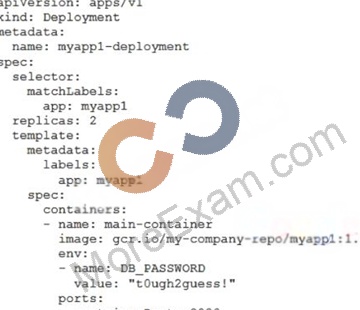
Question3: You've deployed a microservice called myapp1 to a Google Kubernetes Engine cluster using the YAML file specified below:You need to refactor this configuration so that the database password is not stored in plain text. You want to follow Google-recommended practices. What should you do?
Question4: You need to add a group of new users to Cloud Identity. Some of the users already have existing Google accounts. You want to follow one of Google's recommended practices and avoid conflicting accounts. What should you do?
Question5: You have an application on a general-purpose Compute Engine instance that is experiencing excessive disk read throttling on its Zonal SSD Persistent Disk. The application primarily reads large files from disk. The disk size is currently 350 GB. You want to provide the maximum amount of throughput while minimizing costs. What should you do?
Question6: Your development team needs a new Jenkins server for their project. You need to deploy the server using the fewest steps possible. What should you do?
Question7: Your company uses a large number of Google Cloud services centralized in a single project. All teams have specific projects for testing and development. The DevOps team needs access to all of the production services in order to perform their job. You want to prevent Google Cloud product changes from broadening their permissions in the future. You want to follow Google-recommended practices. What should you do?
Question8: Your customer has implemented a solution that uses Cloud Spanner and notices some read latency-related performance issues on one table. This table is accessed only by their users using a primary key. The table schema is shown below.You want to resolve the issue. What should you do?
Question9: You are storing sensitive information in a Cloud Storage bucket. For legal reasons, you need to be able to record all requests that read any of the stored data. You want to make sure you comply with these requirements. What should you do?
Question10: You are building a new version of an application hosted in an App Engine environment. You want to test the new version with 1% of users before you completely switch your application over to the new version. What should you do?
Question11: You need to create a new billing account and then link it with an existing Google Cloud Platform project. What should you do?
Question12: You need to manage a Cloud Spanner Instance for best query performance. Your instance in production runs in a single Google Cloud region. You need to improve performance in the shortest amount of time. You want to follow Google best practices for service configuration. What should you do?
Question13: Your managed instance group raised an alert stating that new instance creation has failed to create new instances. You need to maintain the number of running instances specified by the template to be able to process expected application traffic. What should you do?
Question14: You need to deploy an application, which is packaged in a container image, in a new project. The application exposes an HTTP endpoint and receives very few requests per day. You want to minimize costs. What should you do?
Question15: Your company has a Google Cloud Platform project that uses BigQuery for data warehousing. Your data science team changes frequently and has few members. You need to allow members of this team to perform queries. You want to follow Google-recommended practices. What should you do?
Question16: You have created an application that is packaged into a Docker image. You want to deploy the Docker image as a workload on Google Kubernetes Engine. What should you do?
Question17: 2. Your auditor wants to view your organization's use of data in Google Cloud. The auditor is most interested in auditing who accessed data in Cloud Storage buckets. You need to help the auditor access the data they need. What should you do?
Question18: Your company's infrastructure is on-premises, but all machines are running at maximum capacity. You want to burst to Google Cloud. The workloads on Google Cloud must be able to directly communicate to the workloads on-premises using a private IP range. What should you do?
Question19: You want to run a single caching HTTP reverse proxy on GCP for a latency-sensitive website. This specific reverse proxy consumes almost no CPU. You want to have a 30-GB in-memory cache, and need an additional 2 GB of memory for the rest of the processes. You want to minimize cost. How should you run this reverse proxy?
Question20: You need to set up a policy so that videos stored in a specific Cloud Storage Regional bucket are moved to Coldline after 90 days, and then deleted after one year from their creation. How should you set up the policy?
Question21: You are analyzing Google Cloud Platform service costs from three separate projects. You want to use this information to create service cost estimates by service type, daily and monthly, for the next six months using standard query syntax. What should you do?
Question22: You are managing several Google Cloud Platform (GCP) projects and need access to all logs for the past 60 days. You want to be able to explore and quickly analyze the log contents. You want to follow Google- recommended practices to obtain the combined logs for all projects. What should you do?
Question23: You significantly changed a complex Deployment Manager template and want to confirm that the dependencies of all defined resources are properly met before committing it to the project. You want the most rapid feedback on your changes. What should you do?
Question24: Your company has an existing GCP organization with hundreds of projects and a billing account. Your company recently acquired another company that also has hundreds of projects and its own billing account. You would like to consolidate all GCP costs of both GCP organizations onto a single invoice. You would like to consolidate all costs as of tomorrow. What should you do?
Question25: You are deploying an application to App Engine. You want the number of instances to scale based on request rate. You need at least 3 unoccupied instances at all times. Which scaling type should you use?
Question26: Your company has workloads running on Compute Engine and on-premises. The Google Cloud Virtual Private Cloud (VPC) is connected to your WAN over a Virtual Private Network (VPN). You need to deploy a new Compute Engine instance and ensure that no public Internet traffic can be routed to it. What should you do?
Question27: You have deployed an application on a single Compute Engine instance. The application writes logs to disk. Users start reporting errors with the application. You want to diagnose the problem. What should you do?
Question28: Your organization has user identities in Active Directory. Your organization wants to use Active Directory as their source of truth for identities. Your organization wants to have full control over the Google accounts used by employees for all Google services, including your Google Cloud Platform (GCP) organization. What should you do?
Question29: You have a development project with appropriate IAM roles defined. You are creating a production project and want to have the same IAM roles on the new project, using the fewest possible steps. What should you do?
Question30: You want to configure an SSH connection to a single Compute Engine instance for users in the dev1 group. This instance is the only resource in this particular Google Cloud Platform project that the dev1 users should be able to connect to. What should you do?
Question31: You need to update a deployment in Deployment Manager without any resource downtime in the deployment. Which command should you use?
Question32: You manage three Google Cloud projects with the Cloud Monitoring API enabled. You want to follow Google-recommended practices to visualize CPU and network metrics for all three projects together. What should you do?
Question33: You are using Container Registry to centrally store your company's container images in a separate project. In another project, you want to create a Google Kubernetes Engine (GKE) cluster. You want to ensure that Kubernetes can download images from Container Registry. What should you do?
Question34: You want to verify the IAM users and roles assigned within a GCP project named my-project. What should you do?
Question35: You have been asked to set up the billing configuration for a new Google Cloud customer. Your customer wants to group resources that share common IAM policies. What should you do?
Question36: You have 32 GB of data in a single file that you need to upload to a Nearline Storage bucket. The WAN connection you are using is rated at 1 Gbps, and you are the only one on the connection. You want to use as much of the rated 1 Gbps as possible to transfer the file rapidly. How should you upload the file?
Question37: You want to configure a solution for archiving data in a Cloud Storage bucket. The solution must be cost-effective. Data with multiple versions should be archived after 30 days. Previous versions are accessed once a month for reporting. This archive data is also occasionally updated at month-end. What should you do?
Question38: The core business of your company is to rent out construction equipment at a large scale. All the equipment that is being rented out has been equipped with multiple sensors that send event information every few seconds. These signals can vary from engine status, distance traveled, fuel level, and more. Customers are billed based on the consumption monitored by these sensors. You expect high throughput - up to thousands of events per hour per device - and need to retrieve consistent data based on the time of the event. Storing and retrieving individual signals should be atomic. What should you do?
Question39: You need to set a budget alert for use of Compute Engineer services on one of the three Google Cloud Platform projects that you manage. All three projects are linked to a single billing account. What should you do?
Question40: You need to configure optimal data storage for files stored in Cloud Storage for minimal cost. The files are used in a mission-critical analytics pipeline that is used continually. The users are in Boston, MA (United States). What should you do?
Question41: You have a Google Cloud Platform account with access to both production and development projects. You need to create an automated process to list all compute instances in development and production projects on a daily basis. What should you do?
Question42: Your company has a 3-tier solution running on Compute Engine. The configuration of the current infrastructure is shown below.Each tier has a service account that is associated with all instances within it. You need to enable communication on TCP port 8080 between tiers as follows:* Instances in tier #1 must communicate with tier #2.* Instances in tier #2 must communicate with tier #3.What should you do?
Question43: You have an instance group that you want to load balance. You want the load balancer to terminate the client SSL session. The instance group is used to serve a public web application over HTTPS. You want to follow Google-recommended practices. What should you do?
Question44: You have successfully created a development environment in a project for an application. This application uses Compute Engine and Cloud SQL. Now, you need to create a production environment for this application.The security team has forbidden the existence of network routes between these 2 environments, and asks you to follow Google-recommended practices. What should you do?
Question45: Your VMs are running in a subnet that has a subnet mask of 255.255.255.240. The current subnet has no more free IP addresses and you require an additional 10 IP addresses for new VMs. The existing and new VMs should all be able to reach each other without additional routes. What should you do?
Question46: You need to configure IAM access audit logging in BigQuery for external auditors. You want to follow Google-recommended practices. What should you do?
Question47: You are using Data Studio to visualize a table from your data warehouse that is built on top of BigQuery. Data is appended to the data warehouse during the day. At night, the daily summary is recalculated by overwriting the table. You just noticed that the charts in Data Studio are broken, and you want to analyze the problem. What should you do?
Question48: You have one GCP account running in your default region and zone and another account running in a non-default region and zone. You want to start a new Compute Engine instance in these two Google Cloud Platform accounts using the command line interface. What should you do?
Question49: You want to configure 10 Compute Engine instances for availability when maintenance occurs. Your requirements state that these instances should attempt to automatically restart if they crash. Also, the instances should be highly available including during system maintenance. What should you do?
Question50: You deployed an App Engine application using gcloud app deploy, but it did not deploy to the intended project. You want to find out why this happened and where the application deployed. What should you do?
Question51: You are deploying an application to a Compute Engine VM in a managed instance group. The application must be running at all times, but only a single instance of the VM should run per GCP project. How should you configure the instance group?
Question52: You have an application that looks for its licensing server on the IP 10.0.3.21. You need to deploy the licensing server on Compute Engine. You do not want to change the configuration of the application and want the application to be able to reach the licensing server. What should you do?
Question53: You are managing a Data Warehouse on BigQuery. An external auditor will review your company's processes, and multiple external consultants will need view access to the data. You need to provide them with view access while following Google-recommended practices. What should you do?
Question54: You need to create a Compute Engine instance in a new project that doesn't exist yet. What should you do?
Question55: You are running a data warehouse on BigQuery. A partner company is offering a recommendation engine based on the data in your data warehouse. The partner company is also running their application on Google Cloud. They manage the resources in their own project, but they need access to the BigQuery dataset in your project. You want to provide the partner company with access to the dataset What should you do?
Question56: You are given a project with a single virtual private cloud (VPC) and a single subnetwork in the us-central1 region. There is a Compute Engine instance hosting an application in this subnetwork. You need to deploy a new instance in the same project in the europe-west1 region. This new instance needs access to the application. You want to follow Google-recommended practices. What should you do?
Question57: Your company set up a complex organizational structure on Google Could Platform. The structure includes hundreds of folders and projects. Only a few team members should be able to view the hierarchical structure. You need to assign minimum permissions to these team members and you want to follow Google-recommended practices. What should you do?
Question58: Your company uses BigQuery for data warehousing. Over time, many different business units in your company have created 1000+ datasets across hundreds of projects. Your CIO wants you to examine all datasets to find tables that contain an employee_ssn column. You want to minimize effort in performing this task. What should you do?
Question59: You built an application on Google Cloud Platform that uses Cloud Spanner. Your support team needs to monitor the environment but should not have access to table data. You need a streamlined solution to grant the correct permissions to your support team, and you want to follow Google-recommended practices. What should you do?
Question60: You have a batch workload that runs every night and uses a large number of virtual machines (VMs). It is fault- tolerant and can tolerate some of the VMs being terminated. The current cost of VMs is too high. What should you do?
Question61: You are developing a new web application that will be deployed on Google Cloud Platform. As part of your release cycle, you want to test updates to your application on a small portion of real user traffic. The majority of the users should still be directed towards a stable version of your application. What should you do?
Question62: You want to find out when users were added to Cloud Spanner Identity Access Management (IAM) roles on your Google Cloud Platform (GCP) project. What should you do in the GCP Console?
Question63: You need a dynamic way of provisioning VMs on Compute Engine. The exact specifications will be in a dedicated configuration file. You want to follow Google's recommended practices. Which method should you use?
Question64: You need to assign a Cloud Identity and Access Management (Cloud IAM) role to an external auditor. The auditor needs to have permissions to review your Google Cloud Platform (GCP) Audit Logs and also to review your Data Access logs. What should you do?
Question65: You are developing a new application and are looking for a Jenkins installation to build and deploy your source code. You want to automate the installation as quickly and easily as possible. What should you do?
Question66: You deployed a new application inside your Google Kubernetes Engine cluster using the YAML file specified below.You check the status of the deployed pods and notice that one of them is still in PENDING status:You want to find out why the pod is stuck in pending status. What should you do?
Question67: You are building an application that stores relational data from users. Users across the globe will use this application. Your CTO is concerned about the scaling requirements because the size of the user base is unknown. You need to implement a database solution that can scale with your user growth with minimum configuration changes. Which storage solution should you use?